
 Drainage & Plumbing Ltd
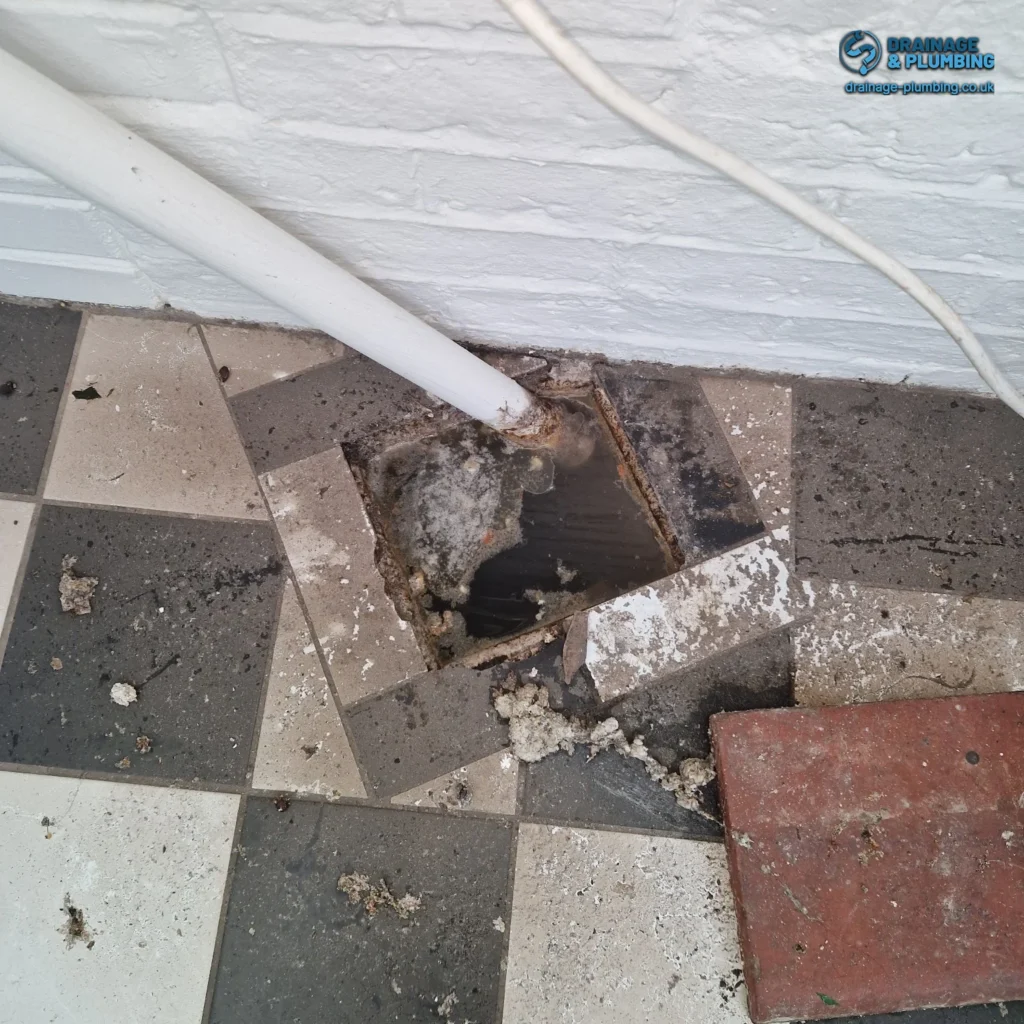
Most gullies that overflow in autumn are blocked by leaves. Wet leaves mat over the grate, rain washes them into the pot underneath, and the silt trap fills until the water has nowhere to go. If the gully is at the kerb in the road, report it to the council. If it is on your own property, by a downpipe or the back door, it is yours to clear, and you can often do it yourself before it needs a jetting unit.
The pattern shows up clearly in the public record. Surrey County Council sent us 18,463 public reports of blocked gullies, blocked drains and road flooding from April 2022 to March 2025, and 66.1% of them came in between October and March. November alone brought 3,087 reports, against 643 in June. Our Surrey blocked gully data report has the full town and street figures.
What is a gully, and why do leaves block it?
A gully is a grated drain at ground level. Under the grate sits a pot, usually 300 to 450 mm deep, which catches silt and leaves before the water passes into the drain pipe. The pot is meant to fill slowly over months. In autumn it can fill within a fortnight.
Dry leaves blow away. Wet ones are the trouble: rain flattens them into a mat on the grate, then they break down into a black sludge in the pot. Add grit from the road or patio, and fat from a kitchen waste pipe if the gully takes one, and the pot sets hard. The grate can look clear while the pot below it is full, which is why water stands round a gully that seems empty from above.
Whose gully is it, mine or the council’s?
It depends on where the gully is and what it drains. This table covers the usual cases in Surrey and South London:
| Where the gully or drain is | Who is responsible | What to do |
|---|---|---|
| At the kerb or in the road | The highway authority: Surrey County Council in Surrey, your borough council in London (Transport for London on red routes) | Report it. Do not lift the grate |
| On your drive or patio, or under a downpipe, serving only your home | You, or your landlord | Clear it yourself, or call a drainage company |
| A drain shared with neighbours beyond your gully | Usually the water company | Report it to the water company first |
| Sewage, not rainwater, coming up | The water company if it is the public sewer; you if it is your own drain | Check whether neighbours are affected, then call |
In Surrey you can report a blocked road drain to Surrey County Council online. If water is blocking a road or pavement and causing a danger, the council’s number is 0300 200 1003. For shared drains and sewers, our guide on who is responsible for a blocked drain explains where your pipe ends and Thames Water’s begins.
How do I clear leaves from my own gully?
A private gully full of leaves is usually a job you can do by hand. Work through this checklist:
- Wear rubber gloves. Gully water can carry sewage if your drains are combined.
- Lift the grid. On a private gully it is usually a small plastic or cast grid that lifts out. Never lift a road gully grate: they are heavy, they sit in live traffic, and the pot below can be a metre deep.
- Scoop the leaves and sludge out of the pot with a trowel into a bucket or bin bag. Do not sweep them down the drain.
- Rinse the grid and pour a bucket of water into the gully. It should run away straight away.
- Clear the gutters and downpipes that feed the gully. Much of what ends up in it comes off the roof.
- Fit a leaf guard or a finer grid in September, before next year’s leaf fall.
If the water still sits after the pot is empty, the blockage is in the pipe beyond it. Drain rods often push a leaf plug further along the run, so that is the point to stop. We saw this at a home in Brighton after Storm Austen, where leaves in a gully had built into a bigger blockage further down the drain.
Why does my gully only overflow when it rains hard?
A part-blocked gully can cope with drizzle and fail in a downpour. Water seeps past the leaves slowly through whatever gap is left. Storm rain arrives faster than that gap can take it, so the pot fills and spills over. If the overflow stops soon after the rain eases, the gully or the pipe just past it is narrowed, not fully blocked. Clear it then, before the next storm finishes the job. Our guide to blocked drains after heavy rain covers the other causes, such as silt and roots.
Which areas see the most blocked gullies?
Among the 175 Surrey towns and villages in the council data, Caterham logged 427 reports over the three years, the sixth highest in the county. Redhill logged 315. Tandridge district, which takes in Caterham, Whyteleafe and Oxted, logged 2,539 reports, 13.8% of the Surrey total. The single worst street was Godstone Road in Whyteleafe, with 76 reports in three years, roughly one every 14 days.
These are road gullies, so most of them are the council’s to fix. A blocked road gully still affects the homes beside it, because the water it cannot take runs onto drives and gardens. The private gullies there block for the same reason: leaves. If you are in Caterham, see our blocked drains Caterham CR3 page, where we are usually with you within 30 minutes. In Redhill, see drain unblocking in Redhill RH1, where we are usually with you within the hour. Other towns are on our areas we cover page.
When should I call a drainage company?
Call when your own gully or outside drain will not clear by hand, or when the signs point past the gully. Ring us if:
- the gully empties and then refills straight away;
- water comes back up the gully when the washing machine or dishwasher empties;
- you can smell sewage around the gully or the drive;
- several drains on the property are slow at once;
- a manhole cover is lifting or overflowing.
Compacted leaves and silt usually need high-pressure water jetting rather than rods. Jetting cuts the sludge off the pipe walls and flushes it out of the run, and we check the flow once it is clear.
Gully overflowing after a storm? Talk to us
Our drain cleaning team clears blocked gullies and outside drains across Surrey, South London and the rest of South East England. You get a fixed price before any work starts. There is no standard call-out fee, with any emergency or out-of-hours charge agreed before attendance.
Tell us where the gully is, whether it is yours or at the kerb, and whether water is still rising.
No comments yet. Be the first to leave a review.
Comments are closed for this post.