
The Drainage & Plumbing Glossary, In Plain English
Every drainage term your engineer might use, explained the way we would explain it to a neighbour — from fatbergs and pitch fibre to soakaways and soil stacks.
We wrote this because of the blank looks. You are standing over an overflowing manhole at 9pm, and the engineer is talking about backfall, a surcharged combined sewer and whether the fault is past your lateral drain — and none of it means anything to you. It should. When you understand the words, you can tell whether you are being levelled with or sold to.
So this is our own glossary, in the plain English we wish more of the trade used. Every entry is written from what we actually pull out of drains across Bromley, Croydon, Epsom and the rest of South London and Surrey — not copied off a manufacturer's datasheet. Where a term links to one of our services, that is the kit or the fix we would actually use for it.
Skim the categories below, or use it as a translator the next time someone in overalls starts a sentence with “the problem is your…”.
Pipes, materials & who owns them
The material your drains are made of tells us most of what we need to know before we even lift a cover. Age, ground movement and who is legally responsible all hang off it.
Lateral drain
The stretch of drain that runs beyond your boundary to meet the public sewer. Since 1 October 2011 most of these transferred to the water company (Thames Water across almost all of our patch), so a blockage out here is usually theirs to clear, not yours — we confirm which side of the line the fault sits on before anyone pays a penny. It is the single biggest source of “who is responsible?” arguments we settle on the doorstep.
Pitch fibre pipe
Cheap-to-lay pipe made from wood cellulose bound in tar, thrown into thousands of 1950s-70s estates — the ones around Orpington and Petts Wood are riddled with it. It does not so much block as fail: the walls blister inward, the bore goes oval, and drain rods just bounce off the deformed sections. Once it has gone, cleaning it is pointless; it needs re-rounding or replacing, which is where our no-dig drain repairs come in.
Combined sewer
An older sewer that carries both foul waste and rainwater in one pipe. It is fine until a downpour — then the extra surface water can surcharge the system and push sewage back up the lowest gully or WC. Large parts of Victorian South London still run on combined sewers, which is why heavy rain and blocked drains so often arrive together.
Misconnection
A waste pipe plumbed into the wrong system — a washing machine or toilet feeding the surface-water drain instead of the foul sewer, or the reverse. It is a slow-burn problem: no blockage, but pollution downstream and drainage that never quite behaves. Tracing the pipework is usually the only way to prove where the crossed wires are.
Saddle connection
A fitting that lets us cut a new branch into an existing sewer without digging up and replacing the whole run — the pipework equivalent of a keyhole operation. Done badly (a common find on older DIY extensions) it protrudes into the pipe and snags everything that passes.
Backfall (fall)
The gentle downhill slope that lets a drain empty itself by gravity alone. Get it wrong and the pipe never self-cleanses: too shallow and solids settle out; too steep and the water races off leaving the solids stranded. Building Regulations Part H puts a 100mm foul drain at around 1:40 — one of the first things we check on a drain that keeps blocking for no obvious reason.
Getting in: access & chambers
Half of drainage is simply reaching the problem. These are the access points and the concrete details that decide whether a job takes twenty minutes or half a day.
Inspection chamber / manhole
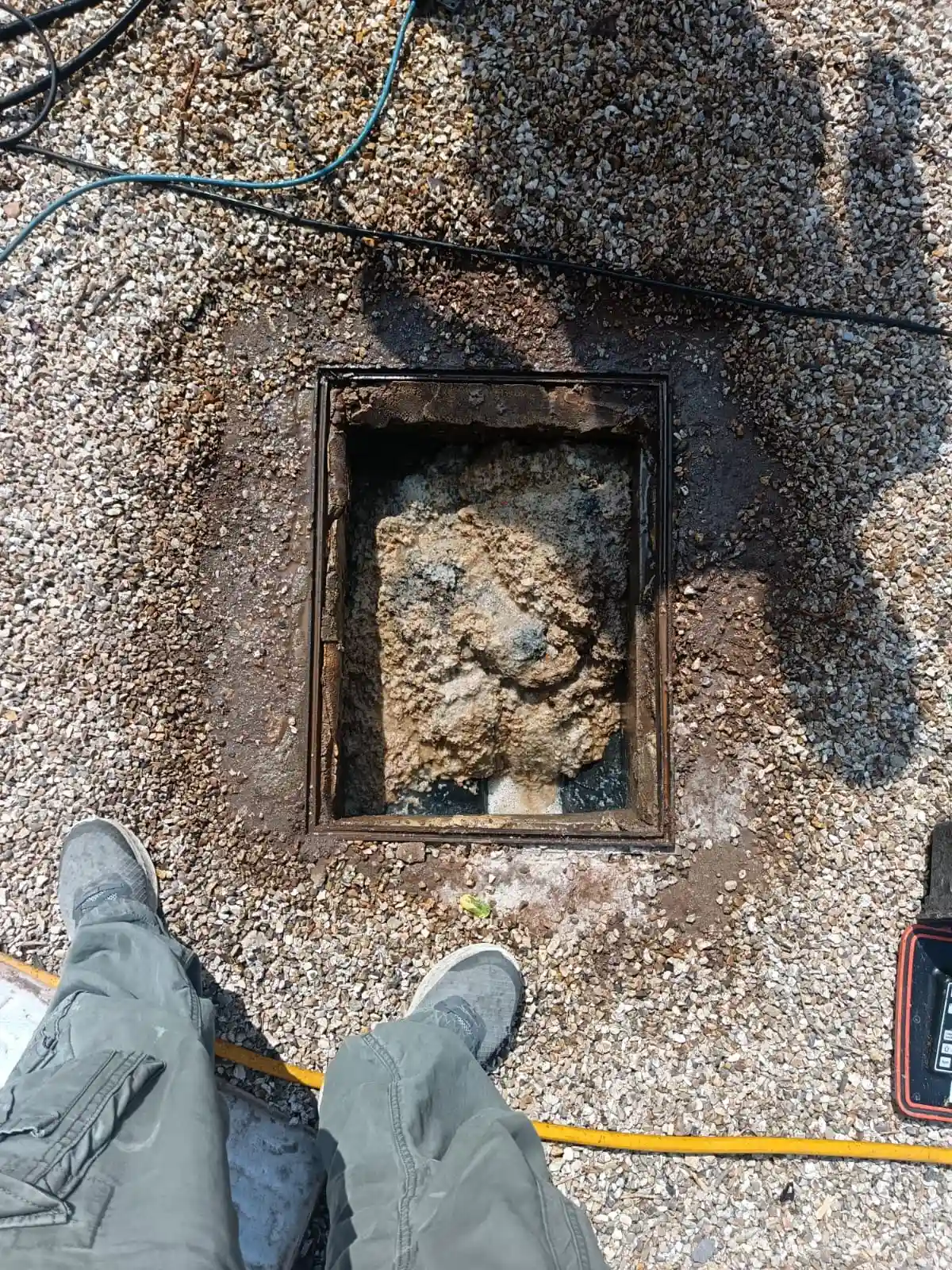
The capped access point that lets us look into, rod or jet a drain without digging. A shallow one you can reach into by hand is an inspection chamber; a deep one built for a person to climb into is a manhole. The first thing our engineer does on almost every job is lift the nearest cover — it tells us instantly whether the blockage is upstream or down.
Rodding eye
A capped, angled access point at the end of a drain run, set so rods can be fed straight into the pipe. On many terraces it is the only sensible way in when there is no chamber near the blockage.
Benching
The smooth sloping concrete shelf inside a chamber that funnels flow into the open channel and stops waste pooling on the floor of the chamber. When benching crumbles — common in old brick manholes — the chamber starts holding water and smelling.
Haunching
The concrete cradle laid around the bottom half of a pipe to hold its line and stop it deforming under the weight of the ground above. Missing or cracked haunching is a frequent reason older pipes sag and then block at the low point.
Blockages & how we shift them
This is the sharp end — what actually stops your drains, and the kit we use to get them running again. Nine times out of ten the cause is one of these five.
Fatberg
The classic main-drain blockage: congealed cooking fat and grease welded together by wet wipes, cotton buds and anything else labelled “flushable” (it isn’t). They build quietly on the pipe wall for months, then close the drain overnight. We clear them with high-pressure jetting rather than poking a hole through — punch a hole and it blocks again by the weekend.
Root intrusion
Tree and shrub roots finding a hairline crack or a loose joint and growing into the pipe after the water inside, forming a fibrous net that catches everything. It is the number-one repeat offender in the Victorian clay runs of places like South Croydon and Epsom. Cutting the roots buys time; the real question is whether the pipe behind them needs repair.
Descaling
Stripping hard-water limescale or old cast-iron scale off the inside of a pipe to bring back its full bore. It matters most in hard-water pockets like Bromley, where scale slowly chokes a pipe until wipes and grease start catching where they never used to.
Surcharge
When a drain or sewer fills completely and backs up under pressure — the moment sewage stops going down and starts coming up through the lowest gully, shower tray or toilet. It is the tell-tale of a blockage downstream of you, or an overloaded sewer in heavy rain, and it is the call we drop everything for.
High-pressure water jetting
Our workhorse. Water fired through a specialist nozzle at up to around 4,000 psi, which scours fat, silt and scale off the pipe wall and cuts through roots — cleaning the pipe back to its full diameter rather than just poking a channel through the blockage. Pressure is matched to the pipe: we ease right off for fragile old clay. See our drain jetting service.
Drain rodding
Screw-together flexible rods pushed by hand to break up a blockage close to an access point. Quick and cheap for a soft blockage a few metres in; useless against roots or scale, where we reach for the jetter. Most of our drain unblocking jobs start with rods and escalate only if needed.
CIPP lining (relining)
Cured-in-place pipe: a resin-soaked liner is drawn into a damaged pipe and cured rock-hard, forming a new pipe inside the old one — a proper repair with no trench across your garden. Not every pipe is a candidate, which is why we check its condition first, but where it fits it is the tidiest fix there is. Part of our drain repair work.
Traps, stacks & smells
Almost every drainage smell in a house traces back to one of these. They are the quiet parts of the system nobody thinks about until something dries out or perishes.
Trap
The water-filled U-bend under every sink, bath, basin and toilet. That trapped water is the seal that keeps sewer air out of the room — let it dry out (a rarely-used guest bathroom is the usual culprit) or siphon away and the smell walks straight in.
Interceptor trap
A deep U-trap, often sat in a chamber at the old boundary of a Victorian property, that seals the house off from the public sewer. Brilliant in its day, a menace now: they silt up and block, and half the owners do not know they have one until we lift the cover.
Soil stack (soil vent pipe / SVP)
The vertical pipe that carries waste from the upstairs toilets and basins down to the underground drain, carried up past the eaves and left open at the top to vent sewer gas and balance the pressure as water rushes down. Cap it off and you get gurgling and slow drainage throughout the house.
Stub stack
A short, capped soil stack used where a full vent up to roof level is not needed — typically fitted with an air admittance valve to do the venting job internally.
Air admittance valve (AAV)
A one-way valve on a stack that opens to let air in when water drains, balancing the pressure, then snaps shut so no sewer smell escapes. It is what lets a modern extension vent without running a pipe all the way up through the roof — handy, but a stuck AAV is a common hidden cause of gurgling.
WC pan connector
The flexible or rigid fitting that joins a toilet outlet to the soil pipe. Cheap, hidden, and the first thing to perish — a leaking or displaced pan connector is behind a surprising share of “sewage smell in the bathroom” call-outs.
Gully
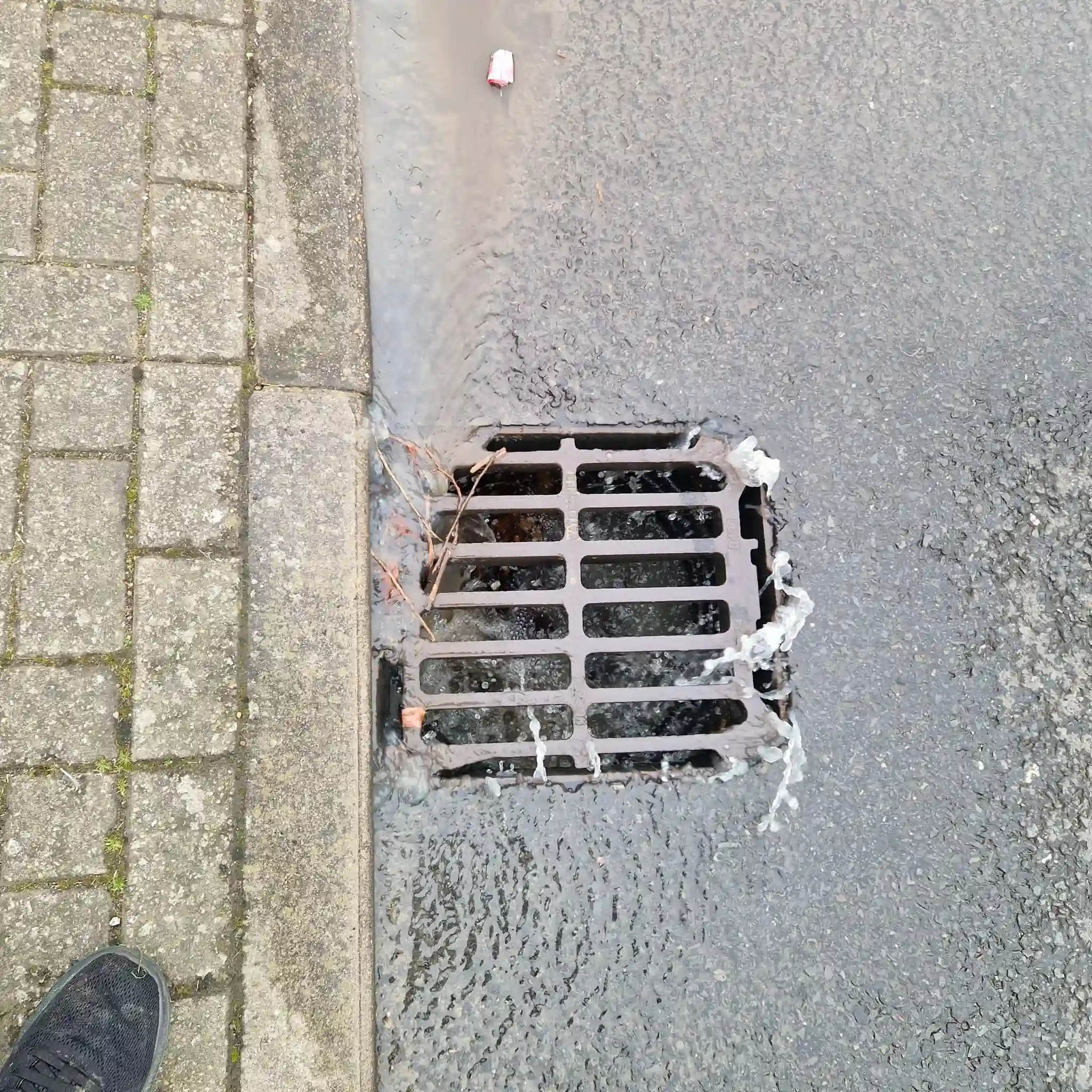
The grated drain at ground level outside that takes waste from sinks, washing machines and rainwater downpipes. When one blocks it overflows across the path — usually the first visible sign of a problem building further down the line.
Where the water goes
Not every drop ends up in the sewer. Where a mains connection is not available, drainage gets designed around the ground itself.
Soakaway
An underground pit filled with rubble or plastic crates that lets surface water drain slowly away into the ground, used where there is no surface-water sewer to connect to. When it clogs or the ground is saturated, the water it should be swallowing ends up pooling on the surface instead.
Penstock
A sliding gate valve set in a chamber that lets us isolate or throttle the flow in a drain or sewer — for example, to hold water back while we carry out a repair downstream.
Words are cheap. Fixing your drain is fixed-price.
Whatever the jargon turns out to mean, a local engineer will take a free look and quote you a fixed price before any work starts — no call-out fee, day or night.
Call 07771 200075