
 Admin
Admin 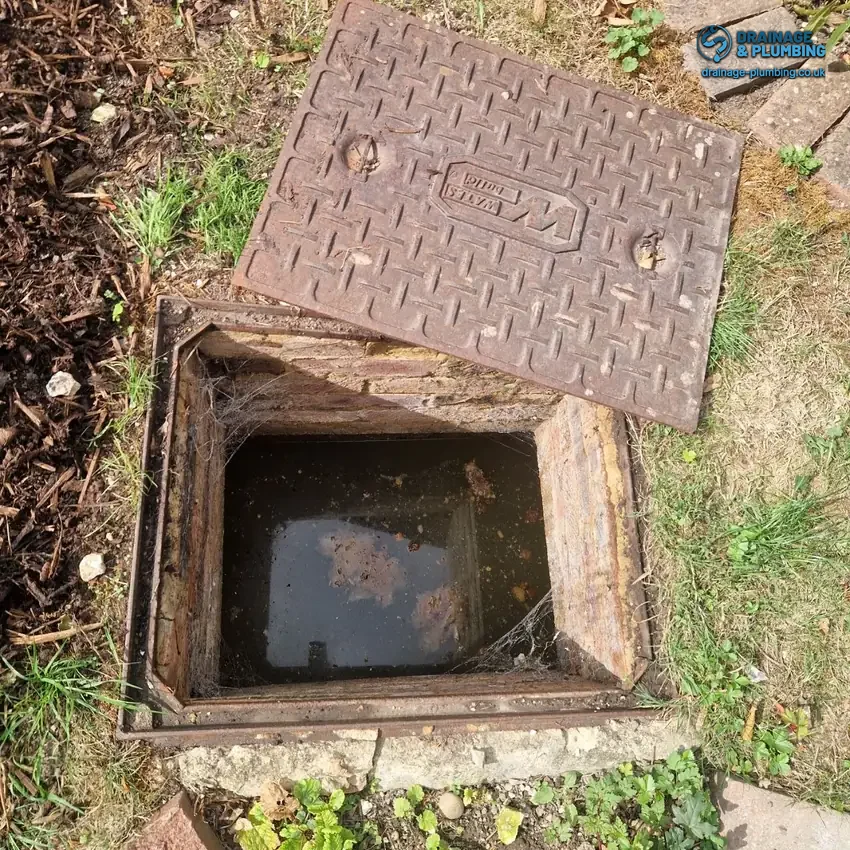
Usually not — a blocked drain on its own is treated as maintenance, and maintenance is excluded from almost every UK buildings policy. What insurance is far more likely to pay for is damage: a drain that has cracked or collapsed, or the mess a backed-up drain has made of your floors and walls. Those are different claims with different answers, and mixing them up is why so many people are told no.
This guide separates the four questions that all get asked as “does my insurance cover drains”, so you can work out which one you are actually asking before you phone anybody.
Policies vary a great deal. Everything below is the general shape of the UK market — your own policy wording is the only thing that decides your claim, so read it or ask your insurer.
First: check it is even your drain
Before insurance comes into it at all, establish whose pipe is blocked. Since October 2011, the sections of drain beyond your property boundary, and any drain shared with a neighbouring property, belong to your water company — not to you.
If the blockage is on their side they will normally clear it free of charge, and no insurance claim, excess or premium increase is involved. A surprising number of people claim on a policy for work that was never theirs to pay for. Our guide on who is responsible for a blocked drain explains how to tell in about ten minutes.
Question 1: will it pay to unblock the drain?
Almost certainly not, under a standard buildings policy. Insurers treat clearing a blockage as upkeep, in the same category as servicing a boiler or clearing the gutters. Fat, wet wipes, silt and root ingress build up gradually, and gradual deterioration is a standard exclusion.
There is one common exception worth checking: home emergency cover. This is usually an optional add-on rather than part of the main policy, and it often does include a callout to clear a blocked drain where the blockage is making the property uninhabitable or unusable. Cover is typically capped at a few hundred pounds and pays for making the situation safe, not for a permanent repair. If you have it, it is the section to look at.
Question 2: will it pay for a collapsed or damaged drain?
This is where buildings insurance is much more likely to respond. Most buildings policies include the underground pipes, drains, cables and tanks serving your home that you are legally responsible for — often listed as “underground services”.
The distinction insurers draw is between a pipe that has failed and a pipe that has worn out:
- Usually covered — sudden and unforeseen damage. A drain crushed by vehicle loading, cracked by subsidence or ground movement, or damaged during other works.
- Usually not covered — wear and tear, gradual deterioration, and pipes that have simply reached the end of their life. Victorian clay pipework that has slowly gone at the joints is the classic decline.
- Depends entirely on the policy — tree root damage. Some insurers cover it, many exclude it outright or cap it, on the grounds that roots are a foreseeable and gradual process.
In practice a lot of claims turn on how the damage is described in the engineer’s report. A survey that says “joint displacement consistent with ground movement” and one that says “general deterioration of aged clayware” describe the same trench and produce different outcomes. That is not a reason to misrepresent anything — it is a reason to get a proper survey rather than a verbal opinion, so the cause is actually established. See how to tell if you have a collapsed drain and how ground movement affects drains.
Question 3: will it pay for the damage the blockage caused?
Often yes, and this is usually the biggest number on the bill. If a blocked drain has backed up and flooded a kitchen, soaked a floor or damaged plaster and skirting, that damage is generally dealt with under the escape of water section of a buildings policy — even where the insurer will not pay a penny towards clearing the blockage that caused it.
So the split on a bad job often looks like this: you pay for the drain clearance, and the insurer pays for the flooring, drying and redecoration. Worth knowing before you decide the claim is not worth making.
If the flooding came from a public sewer rather than your own drainage, that is a separate route again — water companies operate their own compensation schemes for sewer flooding.
Question 4: will it pay to dig up the floor to find the problem?
This is trace and access cover, and it is the section most people never think to look for. It pays the cost of locating a leak or a failure and getting to it — lifting floors, breaking up a drive, excavating — and then putting back what had to be removed.
It is commonly included in buildings policies with its own limit, often somewhere in the region of a few thousand pounds. On an underground drain failure, access is frequently the largest single cost, so check for this before you agree to any excavation.
Before you claim, do the arithmetic
A straightforward drain clearance often costs less than a typical buildings insurance excess. Add the effect a claim has on your premium at renewal, and on smaller jobs claiming can genuinely cost more than paying.
Rough rule: if it is a blockage, just get it cleared. If there is structural damage to the pipe, or water has got into the building, that is when a claim is usually worth making.
How to give yourself the best chance
- Photograph everything before anyone touches it — the standing water, the affected rooms, the open chamber. Once it is cleared and cleaned, the evidence is gone.
- Tell your insurer before major work starts, not after. Most policies require it, and work carried out without notice can be refused.
- Get the cause in writing. A dated report identifying what failed and why is the document a claim stands or falls on.
- Keep every invoice, including emergency clearance — some of it may be recoverable even if the clearance itself is not.
- Do not let a blockage run. If you knew about a recurring problem and left it, an insurer can argue the resulting damage was not sudden or unforeseen.
Need a report your insurer will accept? We work across Croydon, Sutton, Bromley, Purley and the wider Surrey and South London area, and we will tell you honestly whether what we find is a claim or a maintenance job. Call 07771 200075, or see our drain repair service.
Landlords and commercial premises sit under different policies again, and the drainage responsibilities in a lease are often not what people assume. If that is your situation, check the lease before the policy.
No comments yet. Be the first to leave a review.
Comments are closed for this post.