
 Drainage & Plumbing Ltd
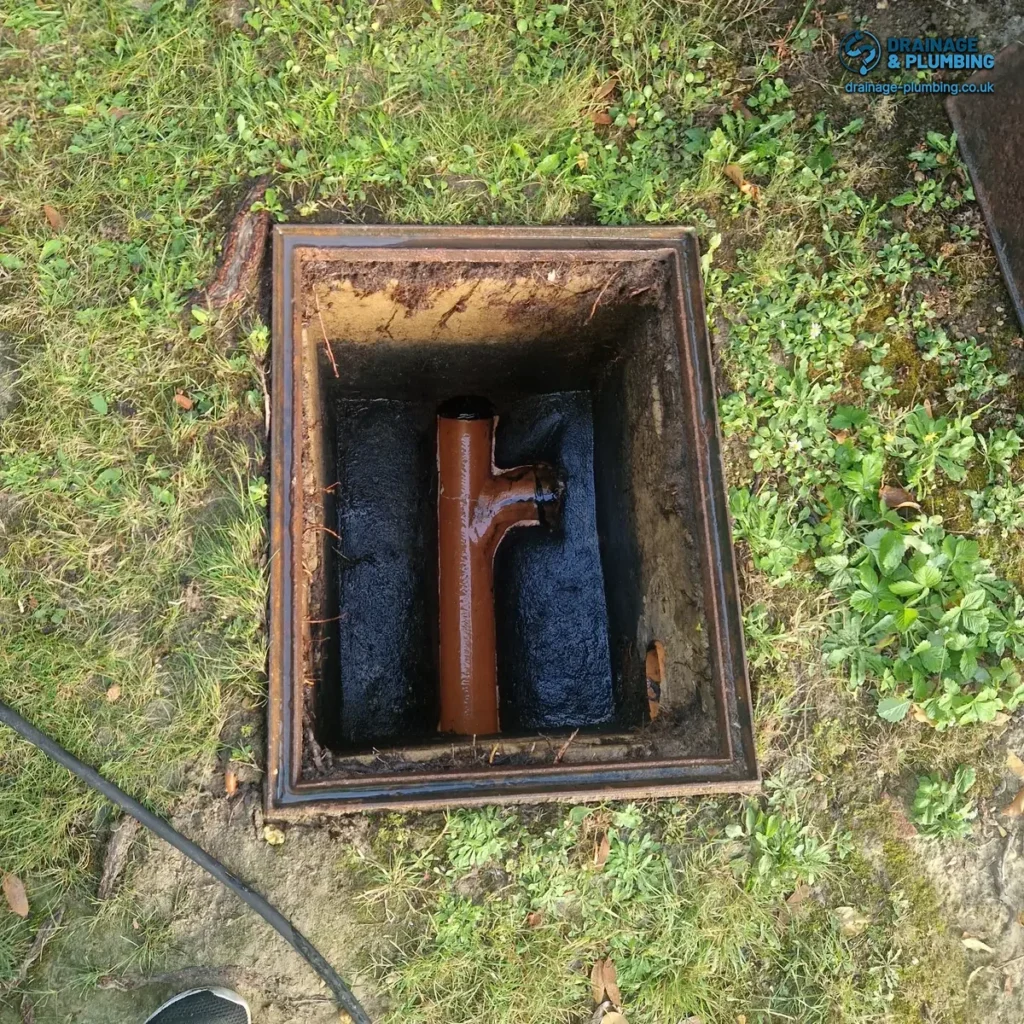
If tree roots have got into a drain that serves only your home and sits inside your boundary, the repair is usually yours to arrange, even when the tree belongs to a neighbour or stands on the street. If the roots are in a drain you share with a neighbour, or in the pipe outside your boundary, it is Thames Water’s to deal with. Whether you can recover the cost from the tree’s owner is a separate question, and it needs evidence.
This guide covers who is responsible in Epsom and Ewell and how a root-damaged drain is repaired. If your drain is blocked right now, our Epsom drain unblocking team is usually with you within the hour.
Why roots get into Epsom and Ewell drains
Epsom sits where the chalk of the North Downs meets clay to the north. Around Ewell and Stoneleigh the ground is clay, which shrinks in dry summers and swells in wet winters. That movement eases the joints of old clay pipes apart, and most houses built before the 1970s have clay drains. Some post-war houses have pitch fibre pipe, which softens and flattens with age.
Roots go where the water is. A fine root finds a hairline gap at a joint, grows inside the warm, wet pipe and spreads into a mat. Wipes and fat catch on it, and the drain starts to block, first slowly and then all at once. The mature street trees and big gardens across Epsom, Ewell and Stoneleigh mean plenty of roots near old pipes. Our guide to tree roots in drains lists the early signs to look for.
Who is responsible for the drain
Responsibility follows the pipe. Thames Water is the sewerage company for Epsom and Ewell; its storm tanks at Longmead Road in Epsom and Bridle Close in Ewell are on its list of overflow sites.
| Where the roots are | Who arranges the repair | |—|—| | Your drain, inside your boundary, serving only your home | You | | A drain shared with a neighbour, even under your garden | Thames Water | | The pipe outside your boundary or the public sewer | Thames Water |
Thames Water says on its sewer pipe responsibility page that you are responsible for drainage pipes within your boundary that serve just your property, and that if your drain joins up with your neighbours’, it owns the joint part. That has applied since 1 October 2011, when private sewers and shared drains transferred to the water companies.
Whose tree is it?
Epsom & Ewell Borough Council’s trees FAQ says the owner of a tree is the owner of the land it is rooted in. For a tree on a boundary, your deeds should show which side most of the stump is on.
- A tree in your own garden: yours, and so is the decision about it, subject to any protection.
- A neighbour’s tree: theirs. Talk to them before anyone cuts anything back, and keep a record of what was found in your drain.
- A street tree: trees by roads and pavements are highway trees. Surrey County Council maintains them through regular inspections and has an online form to report a problem. The borough council’s FAQ gives 0300 200 1003 for trees on or next to the highway.
If you want to claim the repair cost from a tree owner, talk to your home insurer or a solicitor first. Government guidance on protected trees says claims of damage to drains should be backed by technical evidence from a relevant engineer or drainage surveyor, and that is a fair rule of thumb for any claim.
Check for a Tree Preservation Order before any root work
Some trees in Epsom and Ewell are protected by a Tree Preservation Order (TPO) or by being in a conservation area. The borough council’s FAQ says you can check online using its maps, which are for general guidance.
The government’s TPO guidance says an order stops anyone cutting down, topping, lopping, uprooting or wilfully damaging a protected tree without the council’s written consent, and that in the Secretary of State’s view cutting roots also needs consent. There is a narrow exception for the minimum work needed to stop an actionable nuisance that is causing actual damage. Trees in conservation areas need six weeks’ notice to the council before certain work.
In practice, if the tree is protected and the fix means digging near it or cutting its roots outside the pipe, ask the council before the work is booked. The guidance also says engineering solutions should be considered before tree work, and a lined pipe is one of them.
How root damage in a drain is repaired
We cut roots out with a root-cutting head on a high-pressure jetter, which gets the drain flowing. If the joint they came through is still open, they grow back, so the next question is how to seal the pipe.
Our drain repairs page explains the four methods we use:
- Patch repair: a short liner bonded over one damaged joint or crack, from inside the pipe.
- Full relining: a new liner through the whole length, which seals the joints along it.
- Pitch fibre re-rounding: for pitch fibre pipe that has flattened with age.
- Excavation: digging down and replacing the section, used only where the pipe has collapsed or a liner can’t go in.
Patching and relining work from inside the pipe, with no digging near the tree, which helps when the tree is protected. We’ll tell you which method fits your drain and why, and you get a fixed price before any work starts.
Epsom and Ewell tree root FAQ
Will Thames Water remove roots from my drain? Only from the parts it owns: a drain shared with a neighbour, the pipe outside your boundary and the public sewer. Roots in a pipe that serves only your home, inside your boundary, are yours to clear.
Can I cut a neighbour’s tree roots out of my drain? Talk to your neighbour first, and check the council’s online maps for a TPO or conservation area. For a protected tree, government guidance says cutting roots needs the council’s consent, apart from the minimum work needed to stop actual damage.
Does clearing the roots fix the problem? It restores the flow. Roots come back through the same open joint, so a drain that keeps blocking with roots usually needs that joint patched or the pipe relined.
Roots in your drain in Epsom or Ewell?
Call Drainage & Plumbing Ltd on 07771 200075. We cover Epsom, Ewell, Stoneleigh, Ashtead and Epsom Downs 24 hours a day from our base in Purley, about nine miles away, and we’re usually with you within the hour. There’s no standard call-out fee, with any emergency or out-of-hours charge agreed before attendance. See our Epsom page for the areas we cover.
No comments yet. Be the first to leave a review.
Comments are closed for this post.