
 Drainage & Plumbing Ltd team
To use a drain snake, take out the plug or strainer, feed the cable in slowly and turn the handle clockwise as you push. When the cable stops or feels soft, keep turning to hook or break up the blockage, then pull it back out and run hot tap water for two to three minutes.
Last updated: 11 November 2026. From Drainage & Plumbing Ltd, drain unblocking specialists based in Purley, Surrey.
A snake or auger clears most hair and soap blockages in basins, showers and baths. It won’t fix a blocked main drain, and forcing it can crack a plastic waste pipe or a toilet pan. This guide covers the steps, the right tool for each drain, and the signs that it’s time to stop.
What is a drain snake, and is it the same as an auger?
A drain snake and a drain auger are the same basic tool: a flexible steel cable with a coiled tip that you turn by hand or with a motor to break up or pull out a blockage. In the UK, “drain snake” usually means a thin hand-held cable for sinks and showers. “Auger” usually means a drum model with a crank handle, or a toilet auger with a guard that protects the pan.
Manual hand auger (drum snake)
Best for bathroom basins, showers and baths. It handles small blockages of hair and soap, and most hand models carry 5 to 7.5 metres of cable.
Toilet auger
Made for toilets. It has a short, stiff cable and a rubber or plastic sleeve that stops the cable scratching the porcelain. Don’t put a standard drain snake into a toilet, because the bare cable can chip or crack the pan.
Electric or drill-powered auger
Used for longer or stubborn blockages further down the pipe. It’s powerful, and it can damage plastic waste pipes if you push it too hard or use it on a small basin waste.
Drain rods
Screw-together rods for outside drains, manholes and gullies. Most UK homes have 100 mm underground drains, which are too wide for a hand snake. For those, see how to unblock drains outside.
Drain snake vs auger vs plunger vs jetting
| Method | Best for | Reach | Limits |
|---|---|---|---|
| Plunger | A soft blockage close to a sink, bath or toilet outlet | The trap only | Won’t shift hair wound round the trap or anything further down |
| Drain snake (hand cable) | Hair and soap in basin, shower and bath wastes | Usually 5 to 7.5 m | Too thin for 100 mm outside drains; can scratch plastic wastes if forced |
| Toilet auger | Toilets blocked by wipes or paper | The pan and the first bend | Can’t reach the drain beyond the toilet |
| Drain rods | Outside drains, manholes and gullies | As many rods as you join | Hard work on grease, roots and silt; rods can unscrew and get lost in the pipe |
| High-pressure jetting (engineer) | Grease, scale, silt, roots and blockages that keep coming back | The whole drain run | Needs professional equipment and training |
Safety before you start
- Wear rubber or nitrile gloves and eye protection. The cable flicks dirty water as it turns.
- If you’ve already poured a chemical drain cleaner in, don’t snake it. Caustic water can burn skin and eyes. Flush with plenty of cold water first, or tell the engineer what you used.
- Bail out a full basin or bath into a bucket before you begin.
- Work slowly and never force the cable. Most damage we see from DIY snaking comes from pushing too hard.
- Keep the drum close to the plughole so the cable can’t kink or loop back on itself.
How to use a drain snake: 7 steps
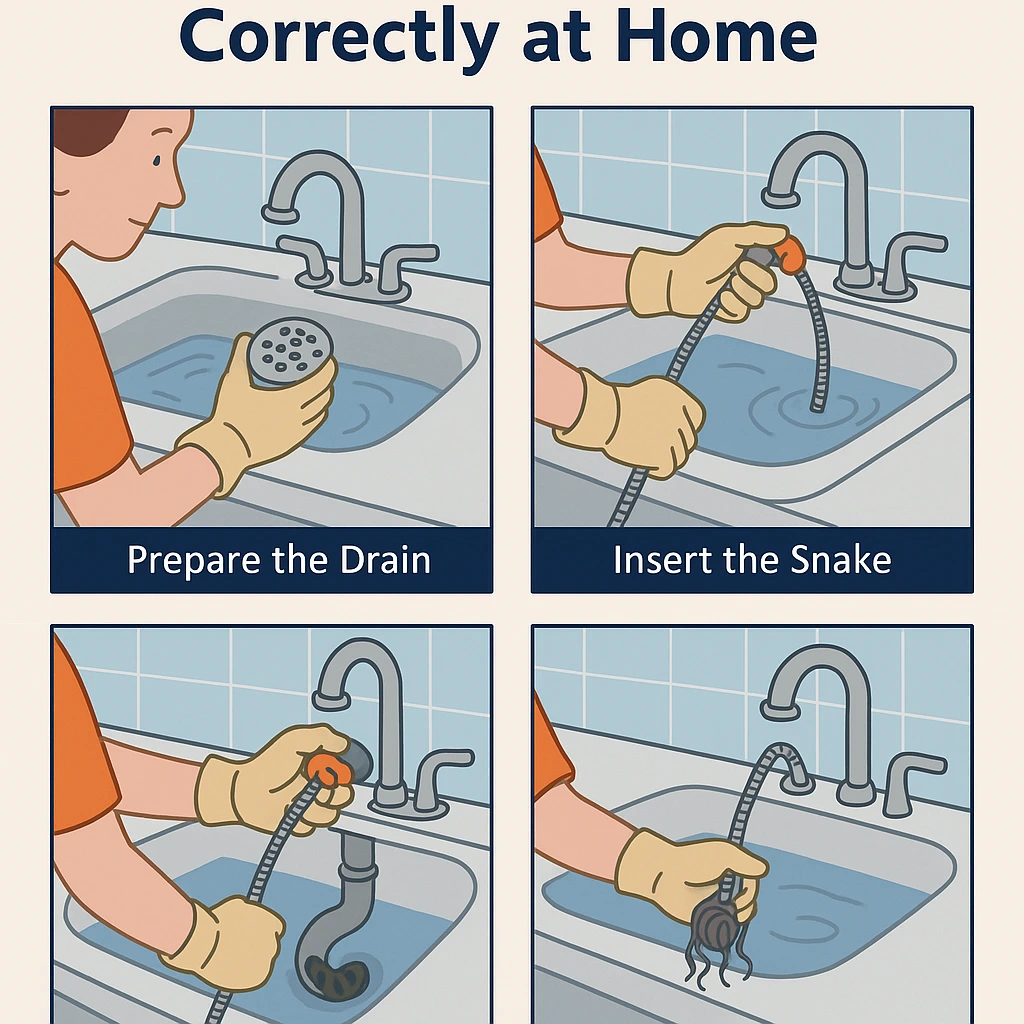
- Get ready. Put on gloves and eye protection, lay old towels down and keep a bucket and a rag to hand.
- Remove the plug or strainer. On a basin, check the trap first: put the bucket underneath, unscrew the U-shaped trap and clean it out by hand. That alone often clears the blockage.
- Feed the cable in. Pull out 15 to 20 cm of cable and push the tip into the plughole, or into the waste pipe if the trap is off. Push gently by hand until you feel the first bend.
- Lock and turn. Tighten the thumbscrew and turn the handle clockwise while pushing gently, so the tip works round the bend. Unlock, pull out more cable, lock it again and carry on. Keep about 10 cm of cable between the drum and the drain.
- Hook the blockage. When the cable stops or feels soft and spongy, you’ve reached the blockage. Keep turning clockwise to hook it or break it up. Don’t push harder.
- Pull it back. Draw the cable out slowly, still turning clockwise, and wipe it into the bucket as it comes out.
- Flush and check. Run hot tap water for two to three minutes, refit the trap and check for drips. If the drain is still slow, try once more. If it’s still blocked after that, stop and read the next section.
How to use a toilet auger
- Pull the cable back into the tube so only the tip shows.
- Rest the sleeve in the bottom of the pan with the curved end pointing into the outlet.
- Turn the handle slowly clockwise while pushing down gently, so the cable feeds into the trap.
- When it stops, keep turning to break up or hook the blockage, then wind it back and flush once to test.
Never force the cable. A toilet pan cracks more easily than most people expect.
What if the drain snake gets stuck?
- Don’t pull hard. You could snap the cable or break the pipe.
- Turn it anticlockwise. Turn the handle slowly the other way while easing the cable back.
- Call an engineer if it won’t move. A cable that’s stuck fast may be caught on a root, a broken joint or a collapsed section. Forcing it can turn a simple clearance into a dig.
When to stop and call a drainage engineer
Stop using the snake if any of these happen. They usually mean the blockage is in the main drain, not the fitting you’re working on.
- More than one fitting is blocked at once, such as the sink and the toilet.
- Water rises in the shower or bath when you flush the toilet.
- Other plugholes gurgle when water drains.
- The manhole or inspection chamber outside is full of water.
- There’s a sewage smell outside or under the floor.
- The blockage comes back within 48 hours. The snake has made a hole through it, but the pipe walls are still coated.
- The cable hits something hard at the same point every time, which can be a root or a broken pipe.
If the blockage is in a drain you share with neighbours, or it’s past your property boundary, your water company is usually responsible for clearing it. That has been the rule in England and Wales since October 2011.
Common mistakes
We attend more than 100 drainage jobs a week across South East England, and these mistakes come up again and again.
- Forcing the cable. Pushing harder cracks pipes and joints and leaves the blockage where it is.
- Using the wrong tool. A sink snake is too small for a 100 mm main drain. It flips over inside the pipe and ties itself in a knot.
- Ignoring a loud clunk. A sudden bang while snaking can mean a cracked pipe or a joint that has come apart.
- Putting it away dirty. Rinse and dry the cable after use, or it rusts and smells.
How to stop blockages coming back
- Fit drain strainers. Cheap mesh covers catch hair and food before they reach the pipe.
- Keep grease out of the sink. Fat sets hard in cold pipes. Wipe pans with kitchen roll before washing them.
- Flush with hot tap water. Run it for a minute after washing up. Avoid boiling water, which can soften plastic joints and crack a toilet pan.
- Use enzyme cleaners. A monthly biological cleaner breaks down soap and organic build-up without harsh chemicals.
Drain unblocking across South East England
If the snake hasn’t worked, our drain unblocking service covers Croydon, Sutton, Wallington and Carshalton, Coulsdon, Bromley and the rest of the South East from our base in Purley. Find your town on our areas we cover page.
We bring kit you can’t hire from a DIY shop:
- Electro-mechanical rodding: a powered cable with a cutting head that reaches far beyond a hand auger and cuts through scale and roots.
- High-pressure water jetting: cleans grease, scale and silt off the pipe walls. Read rodding vs jetting to see which suits your drain.
- Patching and relining: repairs many cracked pipes without digging up the drive.
You get a fixed price before any work starts, and there’s no standard call-out fee, with any emergency or out-of-hours charge agreed before attendance. Call 07771 200075 any time, or book online.
Drain snake questions
What is the difference between a drain snake and an auger?
There’s little difference. Both are flexible cables that you turn to break up a blockage. In the UK, “snake” usually means a thin hand cable for sinks and showers, and “auger” a drum or toilet model with a crank handle.
Should you use a drain snake wet or dry?
Either works. A little standing water is fine and shows you when the drain clears, but bail out a full basin or bath first so the cable doesn’t throw dirty water around. Never snake water that has chemical cleaner in it.
Why won’t my drain unclog even though I used a snake?
The cable may have stopped at a bend or doubled back in a fitting, or the blockage may be further down than it can reach. Grease coating the pipe, roots and broken pipes also beat a hand snake. If two tries fail, the drain usually needs jetting or powered rodding.
How often should you snake a drain?
Only when it’s slow or blocked. You don’t need to snake drains as routine care, and frequent snaking can scratch plastic wastes. If the same drain needs it more than once or twice a year, there’s a build-up the snake can’t remove.
Can a drain snake or toilet auger damage pipes?
Yes, if it’s forced or used on the wrong fitting. Plastic wastes, chrome traps, old clay drains and porcelain toilet pans are the most at risk. Use a toilet auger with its guard on toilets, and don’t use a powered auger on a basin waste.
Can you use a drain snake on an outside drain?
Usually not. Most UK outside drains are 100 mm pipes, and a hand snake is too thin and short to clear them. Use drain rods through the inspection chamber, or call a drainage engineer.
Should I use chemicals before a drain snake?
No. The turning cable can splash chemical water onto your skin or into your eyes. If you’ve already used a cleaner, flush with plenty of cold water before you start, or leave it to an engineer.