
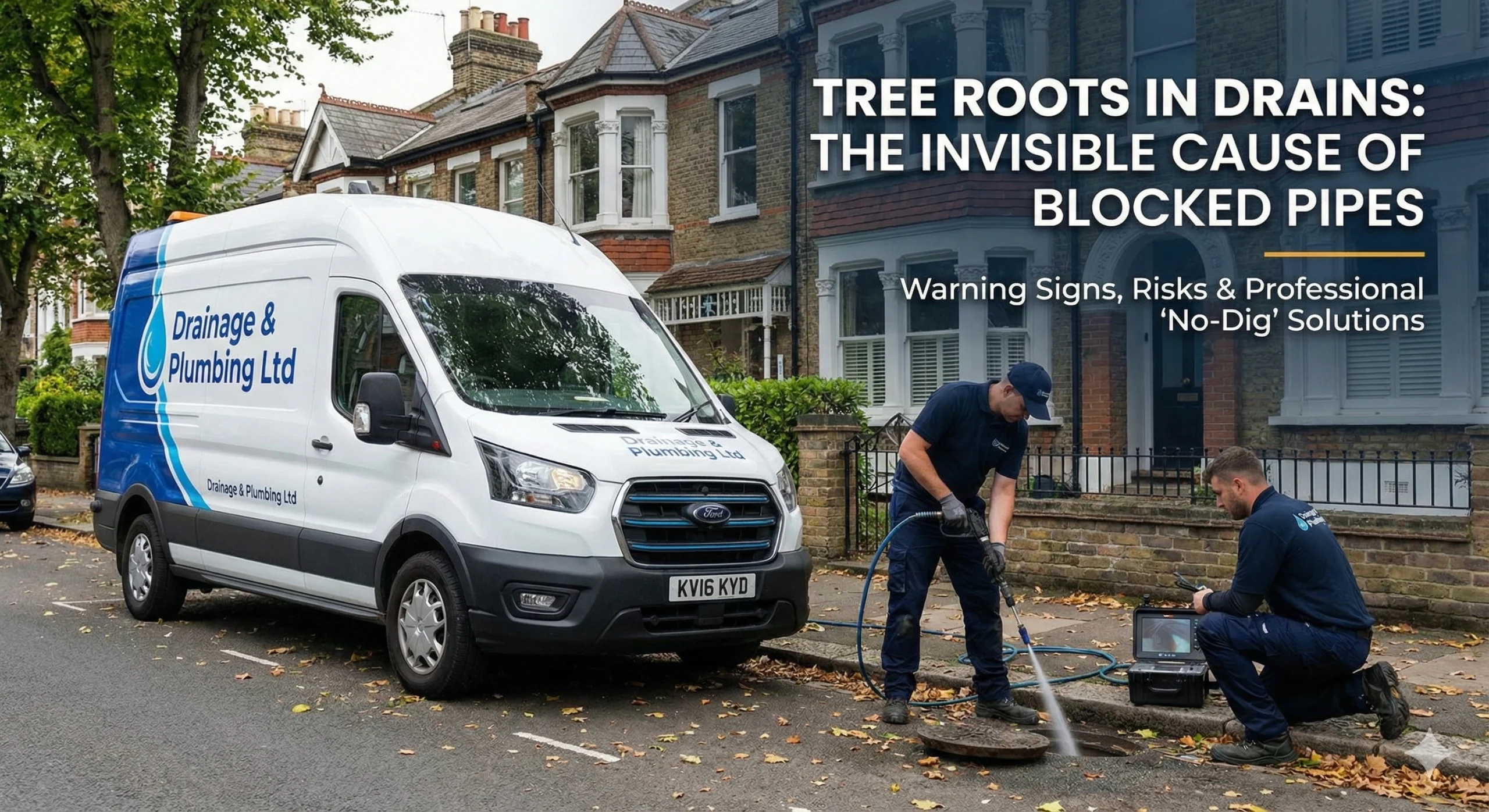
Quick Summary:
- The Root Cause: Thirsty trees seek moisture through tiny cracks in old clay pipes.
- The Warning Signs: Gurgling toilets, slow sinks, and blockages that keep coming back.
- The Reality: Store-bought chemicals cannot kill roots; they need physical removal.
- The Fix: We cut them out and “reline” the pipe from the inside (no digging required).
- Need Help? Call 07771 200075 for a professional assessment.
There is nothing more frustrating than a blocked drain. You plunge it, you pour chemicals down it, and the water finally flows away. You think the problem is solved. But two weeks later, it happens again. And again.
If this sounds familiar, the issue probably isn’t a wet wipe or a buildup of grease. It is likely something far more powerful and persistent living in your garden.
Tree roots.
In properties across South East England, root intrusion is one of the most common—and most damaging—drainage problems we encounter. It is a silent issue that happens underground, often causing significant damage before you even realize there is a problem.
At Drainage & Plumbing Ltd, we have spent years fixing this exact issue. We want to explain exactly why it happens, why “quick fixes” don’t work, and how modern technology allows us to solve it without digging up your entire driveway.
Why Do Trees Attack Drains?
It isn’t malicious; it’s just nature.
Tree roots are biologically programmed to seek out two things: moisture and nutrients. Your drainage pipes are essentially an “all-you-can-eat buffet” for a tree. They contain a constant flow of water and organic fertilizer.
The problem is particularly bad in our service area—Croydon, Bromley, Epsom, and Reigate—because of the housing stock. Many homes here were built in the Victorian or Edwardian eras and still rely on original clay pipes.
Unlike modern plastic pipes, clay pipes are made of short sections joined together. Over decades, the ground shifts (especially in our clay-heavy soil), causing these joints to crack slightly or the mortar to crumble.
That tiny hairline crack is all a tree needs. A root hair—finer than a human hair—sniffs out the moisture, squeezes through the crack, and enters the pipe. Once inside, it drinks the nutrient-rich water and grows rapidly. What started as a single hair quickly becomes a thick, tangled root mass that fills the entire pipe diameter.
The 5 Stages of Warning Signs
Because this happens underground, you can’t see the damage spreading. However, your house will try to tell you something is wrong. Here is what to listen (and look) for:
1. The “Gurgling” Ghost Have you ever flushed the toilet and heard a strange “glug-glug-glug” sound coming from the shower plughole or the sink? That is the sound of air trapped in the pipe. A root mass is likely restricting the airflow, causing the system to choke.
2. The Recurring Blockage This is the biggest giveaway. If you clear a blockage but it returns 14 days later, you almost certainly have roots. You might be clearing the “soft” debris (tissue/waste) caught in the roots, but the “net” (the roots themselves) remains, ready to catch the next batch of waste.
3. Slow Drainage Across the Board If just one sink is slow, it’s a trap issue. If the toilet, sink, and washing machine are all draining slowly, the bottleneck is further down the main line—exactly where trees like to strike.
4. Foul Smells Roots trap waste. Instead of flowing away to the sewer, solids get stuck in the root ball and begin to rot. If you catch a whiff of rotten eggs or sewage near your drains, it’s time to investigate.
5. The Sinkhole In severe cases, water leaks out of the cracked pipe into the surrounding soil. This can cause the ground to erode and sink. If you notice a dip in your lawn or a patch of grass that is suddenly much greener and lusher than the rest, it’s feeding on leaking sewage.
Why You Can’t Fix This With Chemicals
We often arrive at a property to find the homeowner has spent a fortune on heavy-duty drain cleaners from the hardware store.
Here is the hard truth: Chemicals cannot fix root intrusion.
Tree roots are tough, woody structures. No drain cleaner is strong enough to burn through a thick root mass without also destroying your pipes and poisoning the soil. Furthermore, using drain rods can actually make things worse. You might punch a small hole through the roots (restoring flow temporarily), but you haven’t removed the problem. The roots will simply heal and grow back thicker, often within weeks.
The Professional Solution: Cut, Clean, and Reline
So, how do we actually fix it?
Gone are the days when a root problem meant getting a mini-digger in and tearing up your patio. At Drainage & Plumbing Ltd, we use a three-step “No-Dig” process that is faster, cleaner, and permanent.
Step 1: The CCTV Investigation
We never guess. We start by feeding a high-definition CCTV camera down the drain. This allows us to see exactly where the roots are entering, how thick they are, and—crucially—if the pipe structure is still intact. You can even watch the footage with us on the screen so you understand the problem.
Step 2: High-Pressure Root Cutting
Once we locate the enemy, we deploy a specialized high-pressure water jetting head. This isn’t just a hose; it spins at incredible speeds and acts like a liquid buzzsaw. It slices through the fibrous root mass and flushes it out of the system, restoring the pipe’s full diameter.
Step 3: Structural Relining (The “Stent”)
This is the game-changer. Simply cutting the roots isn’t enough—they will grow back through the same crack. To stop this, we install a Cured-In-Place Pipe (CIPP) liner. Think of this like a medical stent for a heart artery.
- We insert a resin-impregnated sleeve into the damaged pipe.
- We inflate it, pressing it hard against the pipe walls.
- It cures and hardens, creating a brand new, seamless pipe inside the old one.
This new liner covers the cracks and joints. The tree roots can no longer “smell” the water, and there are no cracks for them to enter. Problem solved permanently.
Why Waiting is Expensive
The biggest mistake we see homeowners make is ignoring the gurgling noises.
If roots are left to grow, they don’t just fill the pipe; they expand. This exerts massive pressure on the clay pipe from the inside out, eventually causing the pipe to shatter or collapse completely.
Once a pipe has collapsed, we can no longer reline it. The only option left is excavation—digging up the ground to replace the pipe physically. This is significantly more expensive and disruptive than catching the issue early and relining it.
For additional guidance on maintaining drainage systems and understanding shared sewer responsibilities, homeowners can also refer to official advice provided by Thames Water, the regional water authority responsible for wastewater infrastructure in much of South East England.
Frequently Asked Questions
Does home insurance cover tree root damage? It depends on your policy. Many standard policies cover “accidental damage to underground services,” which often includes root intrusion. We can provide the CCTV footage and written reports you need to support an insurance claim.
Which trees are the worst offenders? In our experience across Sussex and Surrey, Willows, Poplars, and Oaks are the most aggressive. However, even large shrubs like Buddleia can cause havoc if planted too close to a drain.
How long does a drain repair take? A simple root cut and clean can take less than an hour. A full relining job is usually completed within half a day—with zero mess left behind.
Ready to Banished the Roots?
If you are tired of unblocking the same drain every month, it is time to get to the root of the problem (literally).
Choose the local experts who know the soil, the trees, and the pipes in this area. We will give you an honest assessment and a permanent solution.
Contact Drainage & Plumbing Ltd today.
📞 Call or WhatsApp: 07771 200075 📧 Email: support@drainage-plumbing.co.uk 🌐 Book Online: https://drainage-plumbing.co.uk/
One Response