
The Hidden Problem Under Your Feet
As a homeowner, you instinctively know the sounds and rhythms of your house. You know which floorboard creaks and which window sticks. But very few of us think about what is happening beneath our feet until disaster strikes. The drainage system is the unsung hero of your property, silently working day and night to keep your home sanitary and dry.
However, when that system fails, it can be catastrophic.
In my years of experience working in the drainage sector, I have seen thousands of blocked pipes. Most are simple clogs caused by grease or wet wipes. But occasionally, we encounter the homeowner’s nightmare: a collapsed drain.
A collapsed drain is not just a plumbing inconvenience; it is a structural threat to your building. One of the most common questions I get asked by concerned residents is: “How can I tell if it’s just a blockage or a collapsed pipe?”
The truth is, while a professional inspection is the only way to be 100% sure, your house will often give you warning signs weeks or months in advance. In this comprehensive guide, I will share the knowledge I have gained over years in the industry to help you spot the symptoms early, save money, and protect your home.
What Exactly is a Collapsed Drain?
Before we look at the symptoms, it is important to understand what we are dealing with. A collapsed drain occurs when the structural integrity of the pipe fails. This isn’t just a crack; it is a fracture or a crushing of the line that prevents waste from flowing.
Depending on the age of your property in South East England, you might have old clay pipes or newer plastic (PVC) ones. While both are durable, they are susceptible to:
- Tree Root Intrusion: Roots seek moisture and can force their way into tiny joints, eventually shattering the pipe.
- Ground Movement: Natural shifting of the soil can shear a pipe in half.
- Wear and Tear: Decades of use can simply cause old clay pipes to crumble.
When the pipe collapses, the water meant for the sewer escapes into the ground surrounding your house. This is where the problems begin.
7 Warning Signs You Have a Collapsed Drain Issue
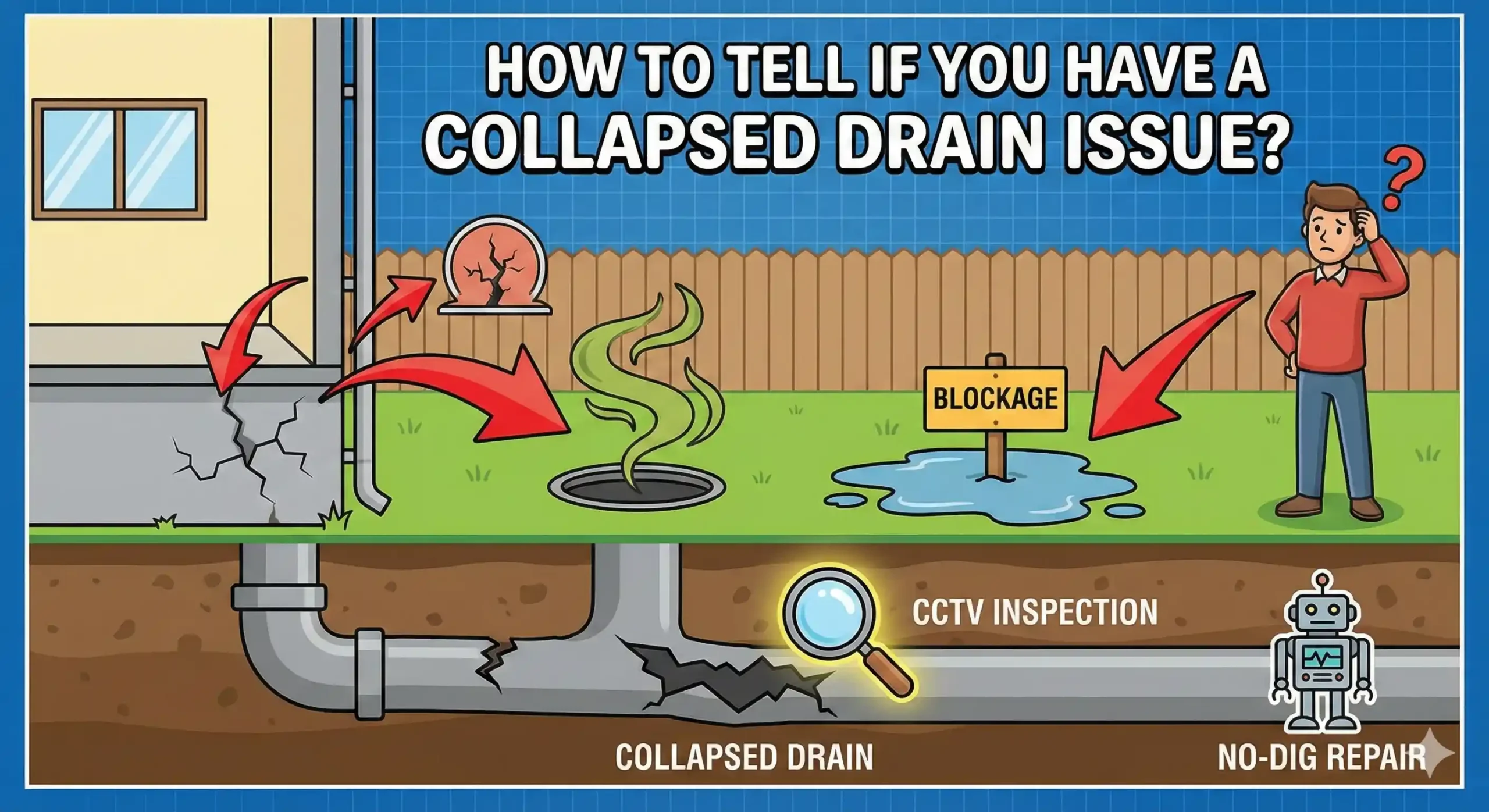
If you notice one of these signs, be vigilant. If you notice two or three, you likely have a significant issue that needs immediate professional attention.
1. Frequent and “Unfixable” Blockages
A standard blockage usually clears with a plunger or high-pressure jetting. However, if you find that your toilet or sink is backing up regularly—perhaps every few weeks—despite your best efforts to clear it, you have a structural problem.
When a pipe collapses, soil and rubble block the line. No amount of drain cleaner can dissolve a piece of broken clay pipe or a stone. If the water drains away slowly but never seems to flow freely, the pipe may be partially crushed, acting like a bottleneck.
2. Sewage Smells (Indoors and Outdoors)
Your drainage system is designed to be airtight to prevent sewer gases from entering your living space. If you start to smell a distinct, rotten-egg odor (hydrogen sulfide) inside your bathroom, kitchen, or even out in the garden, the seal has been broken.
In my years of working in drainage, I have found that a persistent smell near the drain covers or manholes in your garden is often the first indicator that the pipe beneath has fractured, allowing gas to seep up through the soil.
3. Damp, Mold, and “Black Damp”
This is often misdiagnosed as rising damp or a leaky water main. If a drain collapses under or near your property, wastewater is constantly leaking into the foundations. Concrete and brick are porous; they will soak up this dirty water like a sponge.
Look for:
- Damp patches on floors or walls.
- Black mold appearing on skirting boards or low down on walls.
- Peeling wallpaper or bubbling paint near the floor.
If the mold is localized to an area where you know a drain pipe runs, do not paint over it. It is a sign of a deeper issue.
4. Ground Movement and Sinkholes
This is the most alarming sign and requires urgent action. When a drain leaks, water saturates the soil.
- In sandy soils, the water washes the dirt away, creating a void or a “sinkhole.”
- In clay soils, the ground becomes boggy and expands.
You might notice a visible dip in your lawn, cracks appearing in your driveway, or paving slabs in your patio becoming uneven. If the ground near your drain line is sinking, the pipe has likely collapsed and is washing the earth away.
5. Cracks in the Building Structure
Following on from ground movement, if the soil under your house becomes unstable due to leaking wastewater, your foundations can shift. This is known as subsidence.
Keep an eye out for sudden cracks appearing in your plasterwork, specifically zig-zag cracks, or doors and windows that suddenly become difficult to close. This indicates the shape of the doorframe has shifted.
6. Rat Infestations
It is an unpleasant thought, but rats live in the sewer network. Under normal circumstances, they cannot leave the pipes. However, a crack or collapse in the pipe is essentially an open door.
If you have a sudden rodent issue—especially if you hear them under floorboards or in wall cavities—it is highly probable they are entering your home via a compromised drainage pipe.
7. Lush Green Grass
This sounds strange, but it is a classic sign. Sewage acts as a powerful fertilizer. If you notice a specific patch of grass in your garden is growing much faster and greener than the rest of the lawn, it is likely feeding on the nutrient-rich sewage leaking from a pipe directly underneath it.
The Hidden Health Risks
It is not just about the building; it is about your family’s health. A collapsed drain releases raw sewage into your environment. This exposes your household to harmful bacteria like E. coli and Salmonella.
Furthermore, if rats are entering through the breach, you are at risk of Weil’s Disease (Leptospirosis), a serious infection spread by rat urine. Ignoring a collapsed drain is a genuine health hazard.
Why DIY Methods Don’t Work
I admire anyone who tries to fix things themselves. But over my years of experience, I have seen homeowners waste vast amounts of money trying to fix a collapse with drain rods or chemicals.
- Chemicals: Cannot fix a broken physical structure.
- Rodding: Can actually make the collapse worse by dislodging loose debris and completely sealing the pipe.
- Blind Digging: Digging up your garden without knowing exactly where the break is located is expensive, messy, and often results in digging the wrong spot.
The Solution: How We Fix Collapsed Drains
At Drainage & Plumbing Ltd, we use modern technology to diagnose and fix these issues with minimal disruption.
Step 1: CCTV Drain Survey
We don’t guess. We insert a specialized, high-definition camera into your drain. This allows us to see the interior of the pipe on a monitor. We can locate the collapse to the exact millimeter and identify the cause.
Step 2: Sonar Drain Tracing
If we find a collapse, we use sonar equipment above ground to pinpoint exactly where that camera is. This means if we do need to dig, we only dig exactly where necessary.
Step 3: No-Dig Technology (Patch Lining)
In many cases, we can repair the drain without digging at all. We use a technique called “Patch Lining” or CIPP (Cured-in-Place Pipe). We insert a sleeve coated in special resin into the pipe, inflate it, and let it harden. This creates a brand-new, super-strong pipe inside the old one. It is faster, cheaper, and saves your driveway from being excavated.
Why Choose Drainage & Plumbing Ltd?
We are a local company committed to the residents of South East England. We know that drainage issues are stressful, which is why we prioritize transparency and quality.
- Proven Track Record: We are proud to have over 600 positive reviews on Checkatrade and over 100 5-star reviews on Google My Business.
- Local Experts: We serve Croydon, Sutton, Bromley, Orpington, Surrey, and the surrounding areas.
- Insurance Help: Collapsed drains are often covered by buildings insurance. We can help provide the detailed CCTV reports and evidence your insurer needs to process your claim.
Book Your Free Inspection Today
Do not wait for the damp to spread or the ground to sink further. Identifying a collapsed drain early can save you thousands of pounds in structural repairs.
We offer a Free Inspection for residents across South East England.
Let my years of experience and our state-of-the-art equipment give you peace of mind. We will identify the issue and explain your options clearly, with no obligation.