
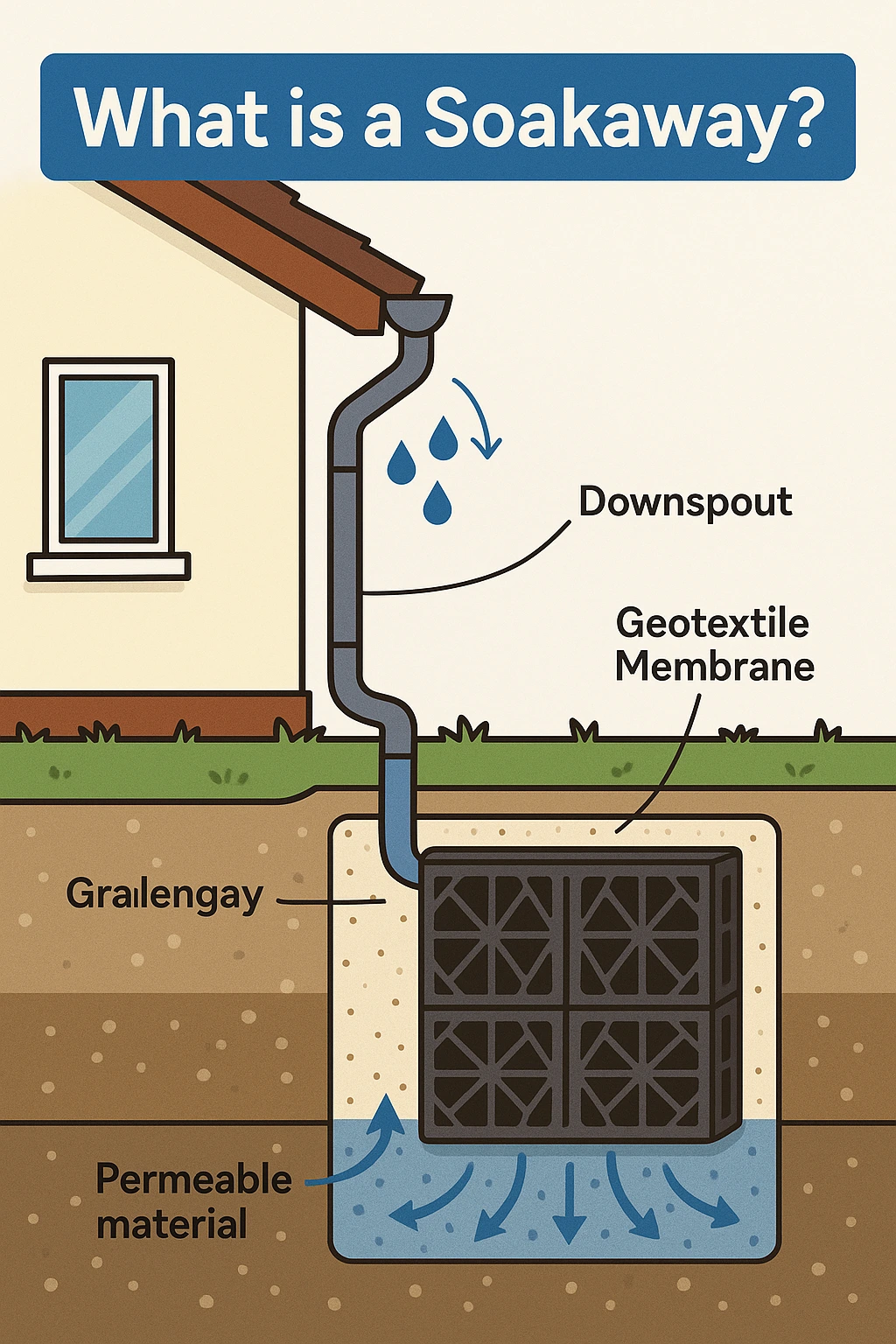
What is a soakaway? A soakaway is an underground drainage system designed to safely disperse rainwater into the surrounding soil. It prevents surface flooding, waterlogging, and long-term damage to your property.
Is your lawn waterlogged days after heavy rain? Are your gutters overflowing or your drains making unusual gurgling sounds? Drainage problems in South East England rarely start with a sudden flood. Instead, they build up quietly over time.
After years of hands-on drainage work across Kent, Sussex, and Surrey, we have seen how surface water issues develop slowly—especially in clay-heavy areas—before eventually failing without warning.
When that happens, homeowners are often told they need a soakaway. Naturally, the next question is: do you really need one, and how does it actually work?
This guide explains how soakaways function, how they perform in local soil conditions, common failure signs, and when professional repair or installation is necessary.
1. The Definition: What Is a Soakaway?
(The Simple Answer for Homeowners)

A soakaway is an underground drainage system designed to manage surface water (rainwater) or the output from septic tanks. Instead of pushing water into the mains sewer network, it collects water in a large underground chamber and allows it to slowly “soak away” (percolate) back into the surrounding soil.
Think of it as a “reverse well.” Instead of taking water out of the ground, it puts water back in, preventing flash flooding and waterlogging on your property.
2. Why Do You Need One? (The Science of Soil)
In the past, rainwater naturally soaked into fields and forests. But as towns like Crawley, Bromley, and Guildford have expanded, we have covered the ground with concrete driveways, patios, and roof extensions.
Without a soakaway, that rainwater has nowhere to go. It pools against your house foundations or floods your garden.
The “South East England” Factor
Your location matters. A standard installation that works in one county might fail in another. We tailor our installations to the specific geology of the South East:
- The Weald (Sussex/Kent borders): This area is heavy in Wealden Clay. Clay holds water, meaning soakaways here need to be larger and scientifically calculated to work effectively.
- The Downs (North Kent/Surrey): These areas often sit on Chalk. Chalk drains incredibly fast, but often requires deeper excavation to reach the permeable layers.
We don’t just dig holes; we assess your specific ground conditions first.
How a Soakaway Actually Works (Step by Step)
Although the idea is simple, a soakaway only works properly when each stage is done correctly.
1. Surface Water Collection
Rainwater from roofs, patios, driveways, and paved areas is directed into gutters and underground pipework. This pipework then carries the water away from the property.
2. Silt and Debris Control
Before water enters the soakaway, it usually passes through a silt trap or catch pit. This step is critical. Leaves, grit, moss, and soil can quickly clog a soakaway if they are not filtered out early.
3. Storage Within the Soakaway Chamber
The filtered water flows into the soakaway chamber. Older systems used loose stone or rubble. However, modern installations almost always use modular plastic soakaway crates. These crates create a large void space, allowing them to hold far more water while using less ground area.
4. Soil Protection Using a Geotextile Membrane
The entire structure is wrapped in a geotextile membrane. This fabric allows water to pass through while stopping soil from entering the chamber. Without this membrane, soakaways fail prematurely.
5. Gradual Percolation Into the Ground
Finally, water seeps slowly into the surrounding soil. This process is called percolation. The speed depends entirely on ground conditions. Sandy soil drains quickly, while clay soil releases water much more slowly.
Once empty, the soakaway is ready for the next rainfall.
When Do You Actually Need a Soakaway?
Many people assume soakaways are only for new builds. In reality, they are needed in far more situations.
New Properties and Planning Regulations
And in many parts of the UK, planning rules require surface water to be managed on-site. Because of this, soakaways are often mandatory for new developments.
Extensions, Garages, and Driveways
Any new structure increases runoff. Therefore adding a drain prevents existing drainage from being overwhelmed.
Ongoing Garden Flooding
If water sits on your lawn for days after rain, it usually means the ground cannot cope with surface water alone. A soakaway can transform drainage conditions.
Older Properties With Outdated Drainage
Many older homes rely on systems that were never designed for modern rainfall levels. In these cases, a soakaway often solves long-standing problems.
Rural and Off-Grid Homes
Properties without surface water sewers depend heavily on soakaways to manage rainwater safely.
The Real Benefits of Installing a Soakaway

A properly installed soakaway delivers long-term value.
- Reduces flood risk by controlling water at source
- Protects foundations from damp and erosion
- Supports sustainable drainage systems (SuDS)
- Minimises maintenance costs
- Improves garden usability year-round
Most importantly, it prevents small drainage issues from becoming expensive emergencies.
Different Types of Soakaways Explained
Traditional Gravel Soakaways
These consist of a pit filled with clean stone. While simple, they require more space and hold less water.
Plastic Modular Soakaway Crates
These modern systems are lightweight, strong, and extremely efficient. Because they store more water in less space, they are now the industry standard.
How Long Does a Soakaway Last?
When installed correctly, a soakaway can last 20–30 years or more. Most failures occur within the first five years and are almost always due to poor design, not age.
Maintenance Tips for Homeowners
Although soakaways are low-maintenance, neglect still causes problems:
- Keep gutters clear: Stops moss from washing down into the pipes.
- Inspect silt traps annually: Remove the sludge so it doesn’t overflow into the main chamber.
- Avoid parking heavy vehicles: Do not park over the soakaway unless it was specifically designed for heavy loads.
- Act quickly: If drainage slows, call a professional. Early attention prevents total failure.
Maintenance: What Homeowners Should Know
Although soakaways are low-maintenance, neglect still causes problems.
- Keep gutters clear
- Inspect silt traps annually
- Avoid parking heavy vehicles above the system
- Act quickly if drainage slows
Early attention prevents total failure.
For stubborn or recurring blockages, professional drain jetting is often the most effective way to fully clear the pipe and prevent the problem from returning.
Frequently Asked Questions
Q: Can I put a soakaway in clay soil? A: Yes, but it is difficult. In heavy clay (common in Sussex), the system needs to be much larger to compensate for the slow drainage speed. We always perform a percolation test first to prove it will work.
Q: How close can it be to my house? A: Under Building Regulations (Part H), a soakaway must be at least 5 metres from any building and 2.5 metres from a boundary.
Q: Do I need planning permission? A: Usually no, as long as the new soakaway keeps water on your own property. However, new driveways over 5 square metres now require a soakaway (or permeable paving) by law under SuDS (Sustainable Drainage Systems) rules.
Q: Can you just “clean” my old one? A: We can use High-Pressure Drain Jetting to clear the pipes leading to the soakaway. However, if the soakaway pit itself is silted up or collapsed, it cannot be cleaned—it must be replaced.
Why Choose Drainage & Plumbing Ltd?
Drainage is not a side-job for us; it is our entire business. We serve the whole of South East England, bringing regional expertise to every job.
- Compliance: Fully compliant with Building Regs Part H.
- Technology: We use CCTV cameras to diagnose the issue before we dig.
- Trust: Fixed quotes, no hidden costs, and comprehensive guarantees on all installations.
Final Advice: Don’t Wait for the Flood
Surface water problems never fix themselves. They only get more expensive the longer you leave them.
Do you suspect a collapsed drain or a blocked soakaway? Get a definitive answer from the South East’s drainage experts.
Call us today on: 07771200075
One Response